Families ask me this question more than any other, usually from New York, New Jersey, or California, usually with a school-age child and a timeline: should we move to Bay Harbor Islands? It deserves a better answer than a listing feed — because it's really four decisions stacked together: an education decision, a daily-life decision, a real estate decision, and an investment decision.
This guide takes them in that order, with evidence where evidence exists and my honest read where it doesn't. It's current as of July 2026, and I update it as the facts change.
Education: the school that anchors the island
Start with the fact that shapes everything else. In the 2025–26 Florida school grades released July 1, 2026, Ruth K. Broad Bay Harbor K-8 Center earned an A — the state's top rating, which it holds consistently year after year. The components behind the grade: 92% achievement in Social Studies, 86% in Mathematics, 82% in English Language Arts, a 90% middle-school acceleration rate, with 100% of students tested.
Here's the part relocating parents consistently misunderstand: Ruth K. Broad is not a magnet, not a lottery, and not an application. It's the zoned neighborhood public school — every child living in Bay Harbor Islands is automatically assigned to it. In a city where families game school boundaries and sweat waitlists, buying an address here is the enrollment strategy. The campus sits on the island itself, at 1155 93rd Street, walkable from most addresses, serving PreK through 8th grade with a Gifted and Talented program.
The comparison that matters isn't against other public schools — it's against the private-school route most high-earning Miami families assume they'll take. Comparable academic quality in this market typically means $40,000 to $60,000 per child per year, before the second child. Ruth K. Broad removes that line item for nine grade levels. (High school is a separate planning question — most families here map that path around eighth grade, and the options depend on your priorities; it's a conversation I have often.)
Daily living: what a family's week actually looks like
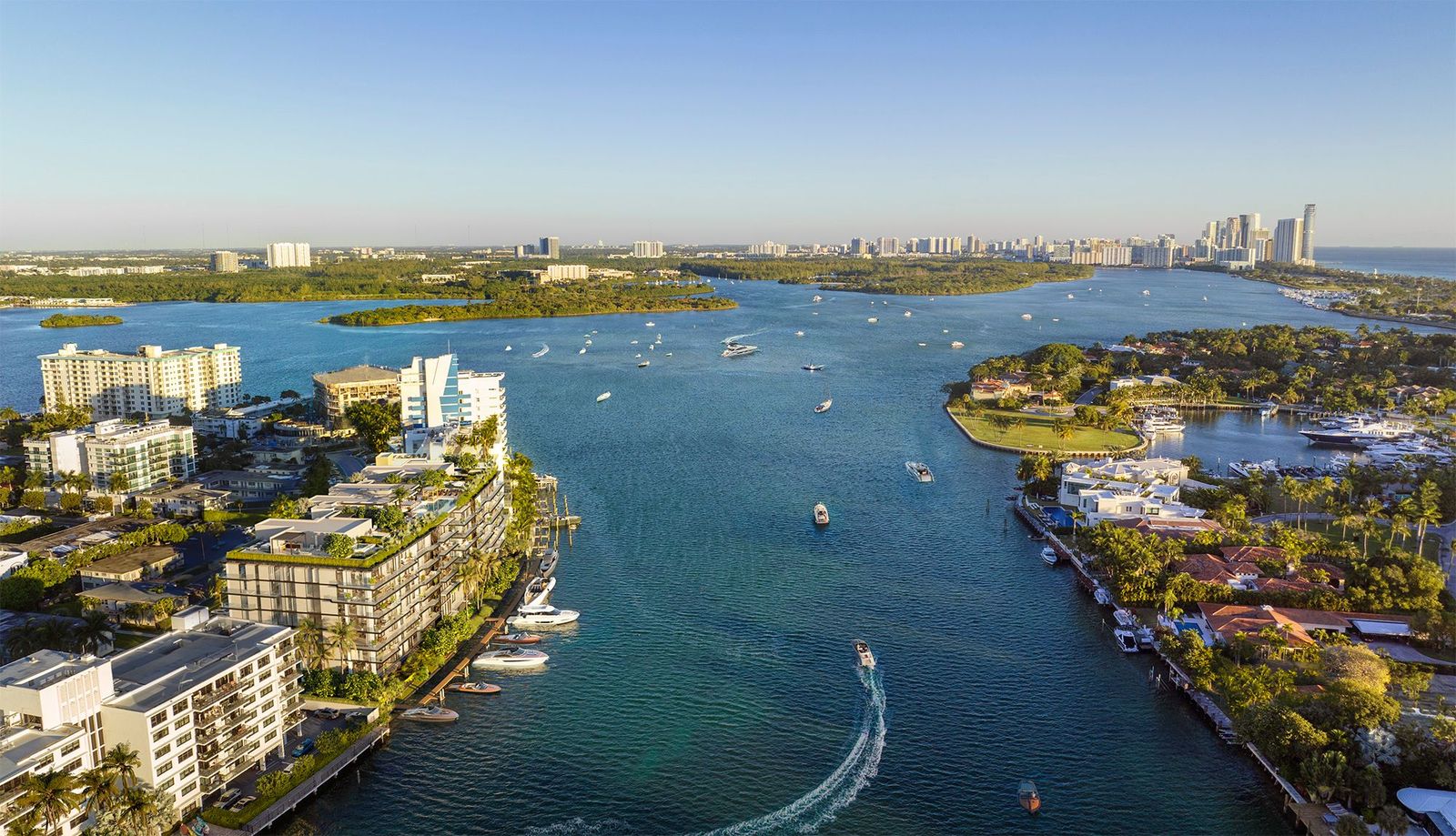
Bay Harbor Islands is two small residential islands connected to the mainland and beach by Kane Concourse — restaurants, coffee, medical offices, and everyday services along one street, quiet residential streets everywhere else. It is bayfront, not oceanfront: Surfside's beach is a short walk or drive across the bridge, but there is no sand on the island itself. Some families rule it out on that alone; more decide the trade — calmer streets, a real neighborhood — is exactly the point.
The rhythm here is set by the school. Mornings move on foot and by bike toward 93rd Street; the streets slow during drop-off and pick-up, which tells you who lives here. The farmers market runs Sunday mornings, and the population is predominantly year-round families rather than seasonal owners — the difference you feel in whether a building's lights are on in September.
The parks are small, close, and specific — you can check each on a map. The one families use most is Officer Scott A. Winters Park at 1135 98th Street — the island's neighborhood park built specifically for families and children, and the busiest one after school lets out. The Bay Harbor Islands Tot Lot at 9600 West Broadview Drive adds a dedicated playground with a pavilion for the youngest kids. 95th Street Park at 1185 95th Street has benches and picnic tables, a short walk from the BHI Tennis Courts at 1126 95th Street, where a resident tennis pro runs the courts. 92nd Street Park, at East Bay Harbor Drive and 92nd Street, is the quieter green space with the dog run. And directly across the Kane Concourse bridge, Surfside's 96th Street Park adds the bigger canvas — multipurpose field, playground, kayak launch — a few minutes from most island addresses. No single park is large; the point is that a child's week touches several of them on foot.
On safety: Bay Harbor Islands maintains its own municipal police department, headquartered on the island at 9665 Bay Harbor Terrace — a dedicated force for a town of roughly half a square mile, whose stated mission is maintaining one of the lowest crime rates in Florida. I'll let the structure speak rather than stack adjectives: a small, fully residential town with its own police force, short blocks, and a school inside the neighborhood.
Can children walk safely to school? From most of the island, yes — that's a defining feature, not a marketing line. Distances are short, streets are residential, and the school sits inside the neighborhood rather than across an arterial road. Which specific streets walk best is part of how I match families to addresses.
Real estate: what family life here actually costs to buy
The island runs on two separate markets, and families need to understand both. In June 2026, Bay Harbor Islands recorded twelve condo closings that split cleanly: eight in established buildings trading between roughly $250 and $630 per square foot, and four in new developments — between about $740 and $1,190 per square foot. Same island, two different price-per-foot worlds that barely overlap.
For families, that split is the actual menu. The established side buys space: the island's older condos and townhouse-style units deliver the bedrooms and square footage a family needs at a fraction of new-development pricing — with the same school zoning, because the school doesn't care which decade your building was built. The new-development side — projects like MILA, ALMA, La Mare, and Bay Villas — buys current construction, amenities, and the premium that comes with them. Bay Villas in particular was built as townhomes, a format families gravitate to. Single-family homes on the island's residential streets are the third option, scarcer and priced accordingly. Which specific buildings suit a family best depends on your children's ages and your budget — that's the walk-first list I build with each family. The full picture of the island's active projects is on the Bay Harbor Islands new developments page.
Investment: does family demand protect the purchase?
The investment case rests on a simple mechanism: the school creates demand that doesn't negotiate like discretionary demand. A buyer who needs the school zone by August doesn't walk away over the last five percent — and there is a fresh cohort of them every enrollment year. That's what "school premium" means in practice: not a higher price for its own sake, but a deeper, more reliable buyer pool when it's your turn to sell.
Is it worth paying more to be zoned for the school? Frame it against the alternative: the tuition a comparable education costs annually. A family avoiding $40,000–$60,000 per child per year can justify meaningful additional purchase price and still come out ahead over a K-8 horizon. The exit question matters too: when your children finish eighth grade, you sell into the next wave of families entering it. The demand that brought you here is the demand that buys you out.
Two honest caveats. First, the island's new-development wave means future inventory — several projects will deliver over the next few years, which is choice for buyers and competition for resellers; which segment you buy into affects how exposed you are. Second, in a market this small, building-level financial health moves individual outcomes more than island-wide trends — the due-diligence list in my condo HOA and special assessments guide applies to every building on this island.
Questions parents actually ask
Is Ruth K. Broad difficult to get into?
No — and this is the most misunderstood fact about the island. It's a zoned neighborhood school with automatic enrollment for Bay Harbor Islands residents. No application, no lottery, no test. If you live here, your child has a seat.
Is private school still worth it if we move here?
Some families still choose private for specific reasons — a particular pedagogy, religious education, or a high-school-through-12th track. But the default assumption that quality requires tuition doesn't hold on this island: the zoned public school posts an A rating with results most privates would advertise. The honest version: private school becomes a choice here, not a requirement.
Can our children walk to school?
From most addresses, yes — short residential blocks, school inside the neighborhood. It's one of the few places in Miami where that's the normal arrangement rather than the exception.
How many families actually live here year-round?
The island is predominantly year-round — school enrollment, weekday traffic patterns, and the Sunday farmers market all reflect a working residential community, not a seasonal one. Precise counts don't exist publicly; what I can tell you is what the buildings and streets show, and it's consistent.
Is Bay Harbor Islands better than Pinecrest for our situation?
Different answer for different families — Pinecrest trades land and yard for commute and a different school structure; Bay Harbor Islands trades lot size for walkability, the bay, and the K-8. It depends on where you work, how you live, and your children's ages. This comparison is worth a full page (it's on my research list) — or a conversation.
The useful next step
If you're weighing this move, the useful next step isn't a listing search — it's a conversation about your specific stack of decisions: your timeline, your children's ages, which of the island's two markets fits, and which buildings to walk first. Request a family relocation consultation, or start with the monthly market brief to watch this market the way I do.