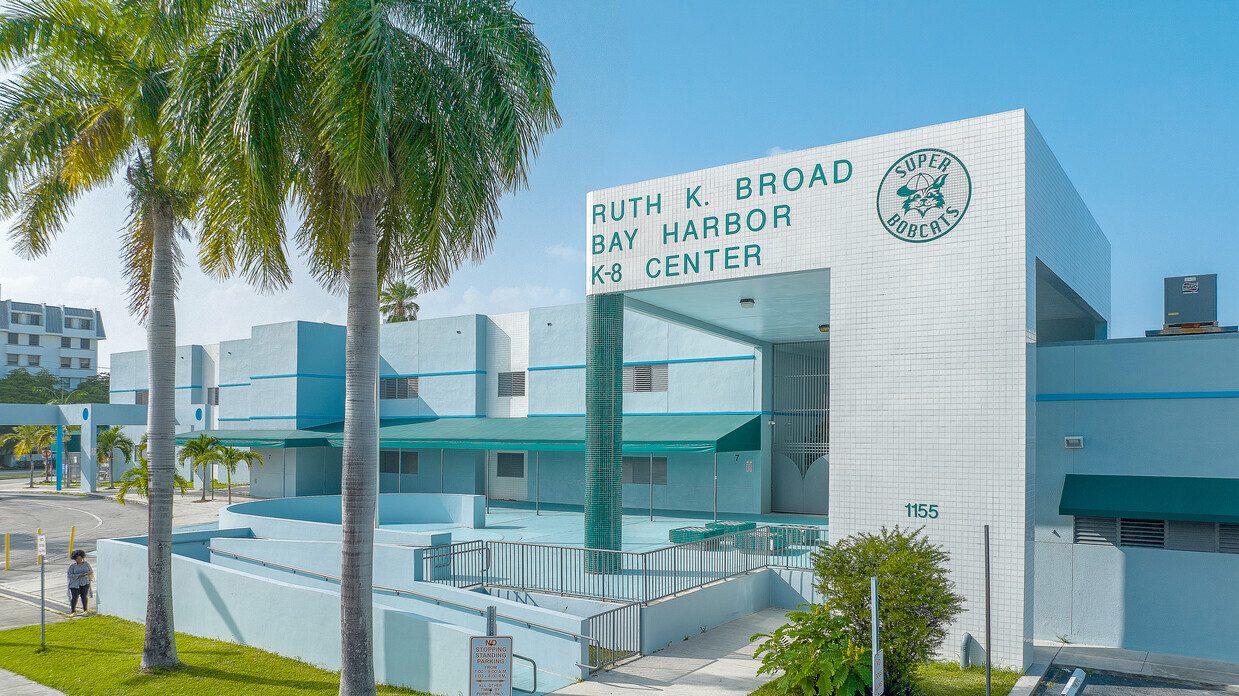
Ruth K. Broad Bay Harbor K-8 Center
Most people think the school question is about education. It usually isn't.
For buyers comparing Bay Harbor Islands to Bal Harbour or parts of Miami Beach, it becomes a question of whether the numbers still make sense once everything is factored in. In most Miami markets, having a school-age child often means private school tuition becomes part of the cost of living. In Bay Harbor Islands, it doesn't have to be.
The zoned public school for the neighborhood is Ruth K. Broad Bay Harbor K-8 Center. It's a true neighborhood school — every child living in Bay Harbor Islands is assigned to it, no application, no lottery, no commuting across the county. The campus sits on the island itself and is walkable from most addresses, which is part of what shapes how families live here day to day.
The consistency is what stands out. In the 2025–26 Florida school grades released July 1, 2026, Ruth K. Broad Bay Harbor K-8 Center earned an A — the state's top rating, which it holds consistently year after year. It currently ranks #16 among all public K–8 schools in Florida and sits within the top 5% statewide. It also holds a 10/10 rating on GreatSchools.
The 2025–26 grade components show where that rating comes from: 92% achievement in Social Studies, 86% in Mathematics, 82% in English Language Arts, and a 90% middle-school acceleration rate, with 100% of students tested. The school earned 78% of total possible points across the state's ten grading components — comfortably above the A threshold.
The academic results reflect that. In the 2024–2025 school year, 100% of students tested proficient in Geometry, 100% in Biology 1, and 98% in Algebra 1. Miami-Dade county averages for those same subjects are significantly lower. The school serves approximately 1,200 students from PreK through 8th grade, with a student-teacher ratio of about 19:1, and includes a Gifted and Talented program.
The financial side of the decision
For many buyers, this is where the conversation becomes real. In Miami-Dade, private school tuition typically starts around $30,000 per year and goes higher depending on the school. In markets like Bal Harbour, Brickell, or much of Miami Beach, that cost is often assumed as part of the equation. In Bay Harbor Islands, it doesn't have to be.
For a family with two children, that's $60,000 to $80,000+ per year that doesn't need to be allocated elsewhere. Over time, that changes what the property actually costs to own — not just what it costs to purchase. This isn't really a lifestyle decision. It's a financial one.
At the same time, some families will still choose private school for their own reasons — curriculum, language, or specific programs. The difference here is that it becomes a choice, not a requirement. And that distinction matters. I see it show up in negotiations all the time. Once a family is clear on the school, the decision becomes more focused. The price still matters, but it stops being the only variable.
What this does to the market
School quality doesn't just affect families — it affects how the market behaves. Buyers who come specifically for the school tend to stay longer. They're not as reactive to short-term shifts, and they're not making decisions based purely on price.
That shows up in subtle ways: stronger closing behavior, less hesitation once aligned, and more stability over time. It creates a different kind of demand than you see in more transient parts of Miami.
What you notice living here
Beyond rankings and numbers, what matters is what the school produces. You see it in the rhythm of the neighborhood — families walking in the morning, familiar faces, routines that repeat week after week. It doesn't feel seasonal or temporary in the way some nearby areas can. Buyers coming from places where that kind of structure exists tend to recognize it quickly. It's not something Miami produces often. That year-round rhythm is driven in large part by families organizing their daily lives around a school they can actually walk to.
Before you make a decision
If schools are part of your decision, there are a few things worth checking early. Zoning in Miami-Dade should always be verified at the address level before making an offer. Boundaries can be specific and do change, and it's a simple step that avoids issues later.
Some buildings in Bay Harbor Islands also have occupancy or age-related rules that don't always show up clearly in listings. Those details affect which buildings truly work for full-time families versus seasonal use. If you're relocating, school enrollment should be part of the timeline from the beginning, not something handled after closing. Most markets treat school as one of many variables. In Bay Harbor Islands, it tends to shape everything around it.